
Let’s be blunt: if you’re an engineer worth your salt, you know the grid isn’t just about kilowatts. It’s about kilovolt-amperes (kVA), and a significant chunk of that kVA is often wasted on something most management types barely comprehend: reactive power. This isn’t some esoteric academic concept; it’s the phantom load that inflates your utility bills, bogs down your infrastructure, and silently saps the usable capacity from your transformers and feeders. While everyone chases the next “cutting-edge synergy” in energy efficiency, many facilities are bleeding money and capacity because they’ve ignored the fundamental physics of AC power.
We’re talking about the magnetizing current for motors, the reactive component drawn by transformers, and the charging current for capacitive elements. This energy sloshes back and forth between the source and the load, doing no real work but consuming current and causing losses. It’s like paying for a delivery truck that drives to your door, unloads nothing, and drives back, only to repeat the process all day. You’re still paying for the fuel, the driver, and the wear and tear. That’s reactive power, and if you’re not actively managing it, you’re paying an invisible tax.
The Problem Nobody Talks About
The problem isn’t just the direct cost from utility penalties, which are often significant and clearly itemized as “reactive power charges” or “power factor penalties” on your bill. The real insidious costs are the indirect ones: the I²R losses in your cables, transformers, and switchgear that manifest as heat, reducing equipment lifespan and increasing cooling loads. It’s the reduced system capacity – a transformer rated for 1 MVA can only deliver 700 kW of active power if your average power factor (PF) is 0.7. Correct that to 0.95, and suddenly you’re delivering 950 kW from the same transformer, without upgrading a single piece of hardware. That’s a 35% increase in usable capacity, just by being smart about your reactive component.
Consider a medium-sized industrial facility, say a plastics extrusion plant, operating with an average power factor of 0.8. Their utility contract penalizes them for anything below 0.95. For a peak demand of 2 MW, their apparent power (S) is 2 MW / 0.8 = 2.5 MVA. This means their internal distribution network, transformers, and feeders are sized for 2.5 MVA, but only 2 MW is doing useful work. The reactive power (Q) is √(2.5² - 2²) = 1.5 MVAR. If they correct their power factor to 0.98, the apparent power drops to 2 MW / 0.98 ≈ 2.04 MVA. The reactive power drops to √(2.04² - 2²) ≈ 0.4 MVAR.
This isn’t just an academic exercise. This reduction from 1.5 MVAR to 0.4 MVAR means significantly less current flowing through their internal infrastructure for the same active power delivered. Less current means less heat, less voltage drop, and more headroom before hitting thermal limits on their existing equipment. It’s found money, sitting there, waiting for someone to claim it.
Technical Deep-Dive
At its core, reactive power compensation is about minimizing the phase angle (φ) between voltage and current in an AC circuit. In a purely resistive circuit, voltage and current are in phase (φ = 0°), and the power factor is 1.0. Inductive loads (motors, transformers, induction furnaces) cause the current to lag the voltage, resulting in a lagging power factor (PF < 1.0). Conversely, capacitive loads (like long underground cables or poorly managed capacitor banks) cause the current to lead the voltage, resulting in a leading power factor. Most industrial loads are inductive.
The fundamental relationships are:
- Apparent Power (S): The total power flowing in the circuit, measured in kVA. S = V * I.
- Active Power (P): The useful power that performs work, measured in kW. P = S * cos(φ).
- Reactive Power (Q): The power that oscillates between source and load, building magnetic fields, measured in kVAR. Q = S * sin(φ).
- Power Factor (PF): cos(φ) = P / S.
The goal of reactive power compensation is to inject or absorb reactive power to bring the system’s power factor as close to unity (1.0) as possible, typically targeting 0.95 lagging to 0.98 lagging to avoid overcompensation.
The primary method for compensating inductive loads is by adding capacitors in parallel with the load. Capacitors draw leading reactive current, effectively canceling out the lagging reactive current drawn by inductive loads.
 Image Credit: researchgate.net
Consider a scenario where a facility has a total inductive load of 500 kW at 0.75 lagging power factor.
- Apparent Power (S) = P / PF = 500 kW / 0.75 = 666.67 kVA
- Reactive Power (Q) = √(S² - P²) = √(666.67² - 500²) = 440.96 kVAR
To improve the power factor to 0.95 lagging:
- New Apparent Power (S’) = 500 kW / 0.95 = 526.32 kVA
- New Reactive Power (Q’) = √(526.32² - 500²) = 164.36 kVAR
The required compensation is Q_comp = Q - Q’ = 440.96 kVAR - 164.36 kVAR = 276.6 kVAR. This amount of capacitive reactive power needs to be injected into the system.
Compensation technologies range from simple fixed capacitor banks to sophisticated Static Var Compensators (SVCs) and Static Synchronous Compensators (STATCOMs).
| Compensation Technology | Type | Response Time | Cost (Relative) | Key Application | Notes |
|---|---|---|---|---|---|
| Fixed Capacitor Bank | Passive | N/A | Low | Constant loads, base load compensation | Simple, robust, but can lead to overcompensation with varying loads. Risk of resonance with harmonics. |
| Automatic Switched Bank | Passive | Seconds | Medium | Moderately varying inductive loads | Utilizes contactors or thyristors to switch capacitor steps. Most common industrial solution. |
| Static Var Compensator | Dynamic | Milliseconds | High | Rapidly varying industrial loads (e.g., arc furnaces), voltage support | Thyristor-controlled reactors (TCR) and fixed capacitors. Can absorb and inject reactive power. |
| STATCOM | Dynamic | Microseconds | Very High | Grid-level voltage stability, flicker mitigation, high-speed reactive support | Uses voltage-source converters (VSCs). Superior dynamic response, smaller footprint, better harmonic performance. |
| Active Power Filter | Dynamic | Microseconds | Very High | Harmonic mitigation, power factor correction for non-linear loads | Primarily for harmonics, but can also provide reactive power compensation. More complex and expensive. |
 Image Credit: researchgate.net
The selection of technology depends heavily on the load profile, the required speed of response, and the presence of harmonics. For most industrial and commercial applications, automatic switched capacitor banks provide the best balance of cost and performance. These systems use a power factor controller (PFC) that continuously monitors the system’s power factor and switches capacitor steps in or out to maintain the target PF.
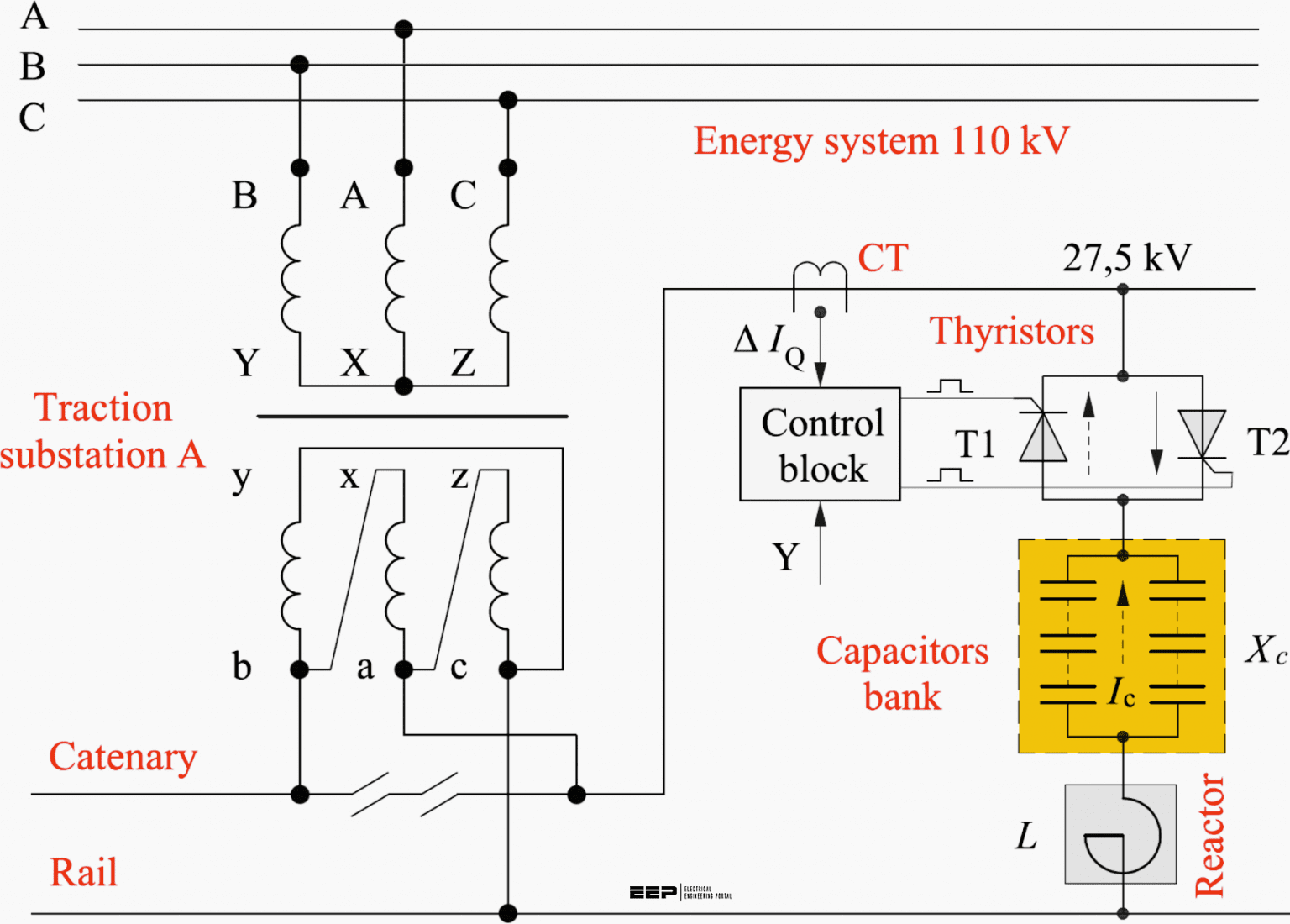 Image Credit: Electrical Engineering Portal
Implementation Guide
Implementing reactive power compensation isn’t just about throwing capacitors at the problem. It requires a systematic approach:
- Load Analysis: The first step is a detailed power quality analysis. This involves deploying power quality meters at the main incoming service and critical loads to capture real-time data on active power, reactive power, apparent power, voltage, current, harmonics, and power factor over a typical operational cycle (e.g., 7 days). This data reveals the minimum, average, and peak reactive power demand, as well as the variability of the load. This is crucial for sizing and selecting the right compensation equipment.
- Determine Target Power Factor: Consult your utility bill for penalty thresholds. Most utilities penalize below 0.95 lagging. Aim for 0.98 lagging, but be cautious about hitting unity or going leading, especially with switched capacitor banks.
- Select Compensation Type:
- Fixed Compensation: Suitable for large, constantly operating inductive loads (e.g., a large motor that runs continuously at full load). The capacitor bank is sized to compensate a portion of the reactive power of that specific load and is switched with the load.
- Group Compensation: A single capacitor bank connected to a busbar supplying a group of loads. Effective if the group’s load profile is relatively stable.
- Central Compensation: A large capacitor bank installed at the main distribution board or substation. This is the most common approach for overall power factor improvement and is almost always automatic switched.
- Dynamic Compensation (SVC/STATCOM): Reserved for highly volatile loads (e.g., arc furnaces, rolling mills) or grid-level applications requiring very fast response times for voltage stability. The cost is significantly higher.
- Sizing the Capacitor Bank: Based on the load analysis and target power factor, calculate the total kVAR required. For automatic switched banks, decide on the number and size of steps. Smaller steps allow for finer control and prevent overcompensation. A common configuration might be a 50 kVAR base step, followed by multiple 25 kVAR steps.
- Location: Compensation should ideally be placed as close to the inductive load as possible. This minimizes reactive current flow through upstream feeders and transformers, maximizing their capacity. However, central compensation is often more cost-effective for overall plant PF correction.
- Harmonic Filtering: If your power quality analysis reveals significant harmonic distortion (e.g., total harmonic distortion of current, THDi, >5%), standard capacitor banks can resonate with these harmonics, leading to dangerously high currents and voltages, damaging both the capacitors and other equipment. In such cases, detuned capacitor banks (with series reactors) or active harmonic filters are necessary. Active filters can also provide reactive power compensation simultaneously.
- Controller Configuration: For automatic switched banks, the power factor controller (PFC) needs to be correctly configured. This involves setting:
- Target Power Factor: e.g., 0.98 lagging.
- Switching Delay: Time delay before switching a step in/out to prevent rapid cycling.
- Reconnection Delay: Time delay before a step can be reconnected after being disconnected, allowing capacitors to discharge.
- Step Sequence: How the controller switches steps (e.g., linear, circular, optimized).
- CT Ratio: The current transformer ratio for accurate measurement.
Here’s a simplified workflow for an automatic power factor correction (APFC) panel:
graph TD
    A["Start APFC System"] -->|"Initialize"| B["Monitor System Power Factor (PF)"]
    B -->|"PF < Target Lagging?"| C{"Is PF too low (lagging)?"}
    C -->|"Yes"| D["Identify Required kVAR Step"]
    D -->|"Select Capacitor Bank"| E["Switch ON Capacitor Step"]
    E -->|"Wait for Stability"| B
    C -->|"No"| F{"Is PF too high (leading)?"}
    F -->|"Yes"| G["Identify Excess kVAR"]
    G -->|"Select Capacitor Bank"| H["Switch OFF Capacitor Step"]
    H -->|"Wait for Stability"| B
    F -->|"No (PF within range)"| B
This continuous monitoring and adjustment ensure that the system’s power factor remains within acceptable limits, optimizing grid interaction and minimizing penalties. For more detail on the intricacies of power factor correction, refer to our article on power-factor-correction.
Failure Modes and How to Avoid Them
Ignoring the nuances of reactive power compensation can lead to spectacular failures. It’s not just about installing a box of capacitors and walking away.
Anecdote: The Overcompensated Textile Mill and the Resonant Nightmare
I once consulted for a textile mill in the Carolinas. They had a legacy setup with several large induction motors and a few dozen smaller ones, all contributing to a consistently low power factor around 0.78. Management, in their infinite wisdom, decided to cut costs by installing a fixed 500 kVAR capacitor bank at the main incoming service, rather than an automatic switched unit. The rationale? “It’s cheaper, and the motors run all the time.”
For a few months, things seemed fine. Their power factor improved to 0.92 lagging, and the utility penalties disappeared. Then, they started having intermittent, inexplicable failures. Motor drives (VFDs) would trip, their PLC communication would glitch, and eventually, a critical main breaker tripped on overcurrent, even though the active load wasn’t particularly high. The final straw was when one of their older, larger motors started audibly “singing” and then its stator winding failed catastrophically.
The root cause? Overcompensation and harmonic resonance. The mill’s load profile wasn’t as static as management believed. During night shifts, many smaller motors were shut down, and the larger motors ran at reduced loads. At light loads, induction motors exhibit a more capacitive characteristic due to their magnetizing current relative to the reduced active load. With the fixed 500 kVAR bank still online, the system’s overall power factor shifted from lagging to leading, sometimes as low as 0.8 leading.
A leading power factor causes voltage rise at the point of compensation, stressing equipment. More critically, the mill had several aging VFDs on their newer machines, which are notorious sources of harmonic currents. The fixed capacitor bank, without any detuning reactors, created a parallel resonant circuit with the system inductance. When the 5th and 7th harmonics (generated by the VFDs) happened to coincide with the resonant frequency of this newly formed LC circuit, it acted like an amplifier. Currents and voltages at these harmonic frequencies spiked to dangerous levels, causing:
- Overheating and failure of the capacitor bank itself: (fuses blowing, capacitors swelling).
- Damage to motor windings: The high harmonic voltages caused insulation breakdown and increased eddy current losses.
- VFD tripping: Overvoltage and overcurrent faults due to harmonic distortion.
- PLC communication errors: Interference from distorted waveforms.
- False breaker trips: The RMS current was significantly inflated by harmonic components, exceeding trip settings.
The solution wasn’t simple. We had to remove the fixed bank, conduct a thorough harmonic analysis, and then install an automatic switched capacitor bank that was detuned with series reactors (typically 6% or 7% impedance) to shift the resonant frequency below the problematic harmonics. We also implemented a step-switching logic that prevented the system from ever going into a leading power factor condition, even at minimum load. The upfront cost was higher than their initial “cheap” solution, but it saved them from recurring equipment failures and costly downtime.
Other Common Failure Modes:
- Incorrect Sizing: Too small, and you don’t achieve the target PF. Too large, and you risk overcompensation and voltage rise.
- Ignoring Harmonics: As demonstrated, passive capacitor banks can amplify harmonics, leading to catastrophic equipment failure. Always perform a harmonic study if non-linear loads are present.
- Lack of Maintenance: Capacitors degrade over time, losing capacitance. Fuses blow. Contactors wear out. Regular inspection and testing are crucial.
- Rapid Cycling: If the PFC controller’s switching delays are too short, capacitor steps can be switched in and out rapidly, leading to premature wear of contactors and reduced capacitor lifespan. This also causes voltage flickers.
- Poor Discharge Resistors: Capacitors must discharge quickly after disconnection before reconnection. Faulty discharge resistors can lead to dangerously high residual voltage, damaging the capacitor upon re-energization or posing a safety hazard.
When NOT to Use This Approach
While reactive power compensation is a powerful tool, it’s not a panacea for every power quality issue. There are scenarios where it’s either ineffective, detrimental, or simply uneconomical:
- Predominantly Resistive or Capacitive Loads: If your facility primarily runs resistive loads (e.g., heating elements, incandescent lighting) or already has a leading power factor due to extensive use of VFDs at light loads or long underground cables, adding more capacitors will only worsen the problem. In rare cases of significant leading power factor, shunt reactors (inductors) might be required, but this is far less common in industrial settings.
- Severe Harmonic Distortion: If your system’s Total Harmonic Distortion of Current (THDi) is consistently above 8-10% and your Total Harmonic Distortion of Voltage (THDv) is above 5%, simply adding standard capacitor banks is a recipe for disaster. The risk of harmonic resonance is too high. In these cases, you need to prioritize harmonic mitigation first, either with detuned capacitor banks, passive harmonic filters, or active harmonic filters. Active filters can often provide reactive power compensation as a secondary benefit.
- Extremely Small Loads: For very small commercial or residential consumers, the cost of installing and maintaining compensation equipment often outweighs the savings from improved power factor. The utility penalties might be negligible, or the utility might not even meter reactive power for smaller accounts.
- Highly Dynamic Loads Requiring Instantaneous Correction: While automatic switched capacitor banks react in seconds, some processes (e.g., large welding operations, arc furnaces, railway traction systems) require millisecond-level reactive power control to prevent voltage flicker and maintain stability. For these applications, SVCs or STATCOMs are necessary, but their capital cost is significantly higher, making them unsuitable for general industrial PF correction unless the process absolutely demands it.
- Faulty or Undersized Infrastructure: If your voltage sag is primarily due to undersized cables, overloaded transformers, or poor connections, reactive power compensation will only provide a marginal improvement. Address the fundamental infrastructure issues first. Reactive power compensation helps optimize existing infrastructure, not magically fix grossly inadequate designs.
Conclusion
Reactive power compensation is not sexy. It doesn’t involve AI, blockchain, or “synergistic digital twins.” It’s fundamental electrical engineering – pragmatic, measurable, and often overlooked. Ignoring it is akin to leaving money on the table, year after year. By understanding the basics, conducting proper analysis, and implementing well-designed solutions, you can significantly reduce operating costs, extend equipment life, and unlock hidden capacity in your existing electrical infrastructure. Don’t be the engineer who waits for a catastrophic failure to address the invisible tax on your grid. Get out there, measure your power factor, and make a real impact on your facility’s bottom line.
Hero image: White and gray metal locker.. Generated via GridHacker Engine.


