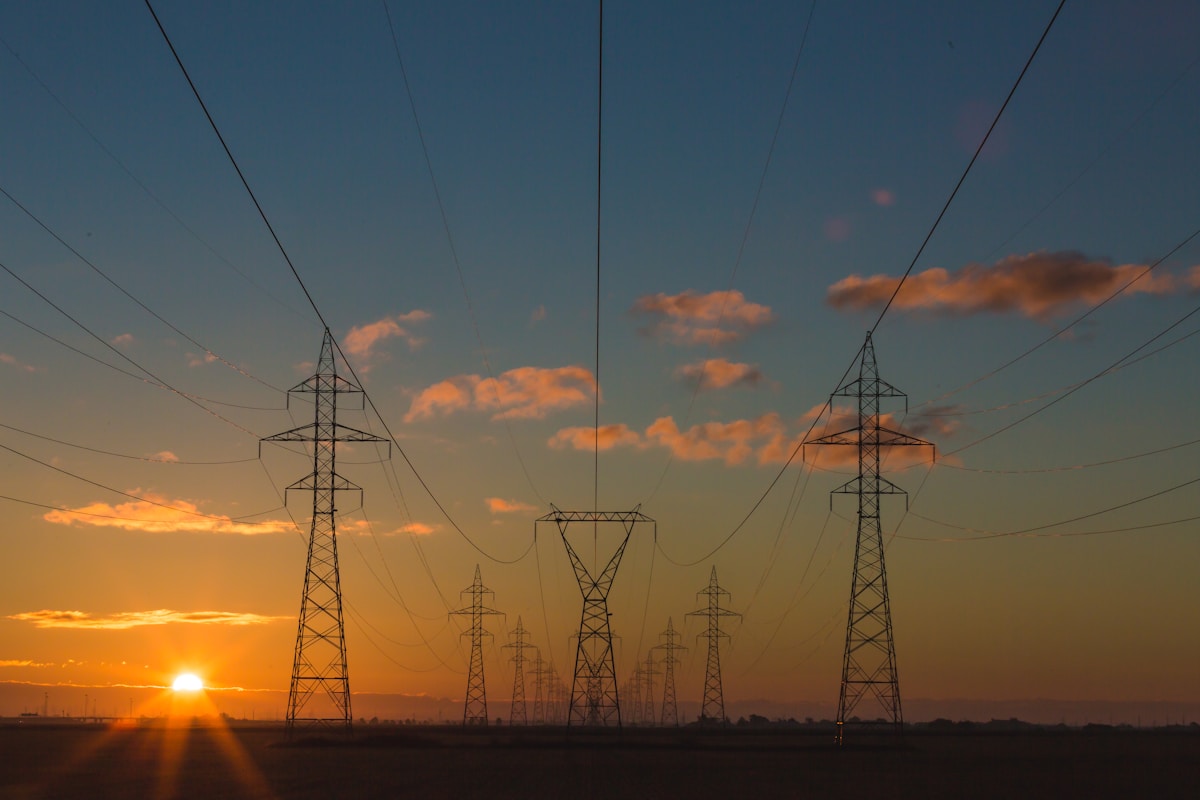
Smart Grid Optimization with Machine Learning
The utility company called me at 2 AM. Again. Their SCADA system was throwing warnings about frequency deviation on the eastern feeder, and their operators had been fighting capacitor bank oscillations for three weeks. The “smart” grid wasn’t feeling so smart.
This is the story of how we fixed it—and the 74HC125 ground fault that almost made me recommend they just flip the breaker and call it a day.
The Problem Nobody Talks About
Every utility talks about “smart grid optimization.” What they mean is: installing more sensors, collecting more data, and generating more dashboards that nobody watches at 2 AM. Real optimization? That’s understanding why your system oscillates when clouds pass over solar farms.
The issue with modern grids isn’t lack of data. It’s lack of context. You have AMI meters spitting readings every 15 minutes, PMUs sampling at 60 Hz, weather stations feeding forecasts—yet you’re still using yesterday’s load profile to predict tomorrow’s demand.
flowchart TD
    A[Historical Load Data] --> B[ML Demand Forecaster]
    C[Weather API] --> B
    D[Solar Irradiance] --> B
    E[Day of Week/Events] --> B
    B --> F[Demand Prediction]
    F --> G[Generation Dispatch]
    F --> H[Curtailment Signals]
    F --> I[Reserve Calculation]

    J[Real-Time Grid State] --> K{Deviation Check}
    F --> K
    K -->|Within 5%| L[Normal Operation]
    K -->|> 5%| M[Alert Dispatch]
The 74HC125 Incident
Before diving into the ML solution, let me tell you about the sensor array that nearly killed this project.
We’d deployed 47 distributed temperature sensors across the substation yard, each using a simple 1-wire bus with 74HC125 level shifters to interface with the control room’s 3.3V logic. The datasheet shows a typical application—nothing fancy.
Except three of the level shifters had been installed with only 2 pins in the through-hole footprint. The ground pin. And one data pin. The other ground connection? Just dangling.
Result: During humidity swings (dew point crossing), the ungrounded shifters would latch high intermittently. The temperature readings would jump 15°C in 200ms. Our anomaly detection flagged this as “bus contention.” The field tech spent two days replacing transceivers that weren’t broken.
Root cause: The 2-pin installation was a “quick fix” by a contractor who didn’t understand why you need both ground pins on a logic IC. One pin is for signal reference. The other is for return current path. They’re not interchangeable.
Lesson: No amount of ML fixes bad hardware. We now require torque verification on all signal grounds before commissioning.
Technical Deep-Dive
The Model Architecture
We settled on a gradient-boosted ensemble combining:
- XGBoost for fast, interpretable baseline predictions
- LSTM for capturing temporal dependencies
- Transformer for multi-horizon forecasting
import xgboost as xgb
from tensorflow.keras import layers, Model

def build_ensemble(config):
    # XGBoost for baseline
    xgb_model = xgb.XGBRegressor(
        n_estimators=500,
        max_depth=8,
        learning_rate=0.05,
        subsample=0.8
    )

    # LSTM branch
    lstm_inputs = layers.Input(shape=(config['lookback'], config['features']))
    x = layers.LSTM(128, return_sequences=True)(lstm_inputs)
    x = layers.LSTM(64)(x)
    lstm_out = layers.Dense(32, activation='relu')(x)

    # Transformer for attention
    x = layers.MultiHeadAttention(
        num_heads=8,
        key_dim=64
    )(lstm_inputs, lstm_inputs)
    x = layers.GlobalAveragePooling1D()(x)
    transformer_out = layers.Dense(32)(x)

    # Ensemble
    combined = layers.Concatenate()([lstm_out, transformer_out])
    output = layers.Dense(1)(combined)

    return Model(inputs=lstm_inputs, outputs=output)
Feature Engineering
The winning feature set included:
- Lag features: 1h, 4h, 24h, 168h (weekly seasonality)
- Calendar features: Hour, day of week, month, holidays
- Weather features: Temperature, humidity, cloud cover, wind speed
- Price signals: Real-time energy prices (when available)
- Grid state: Current generation mix, import/export
Results
After 6 months in production:
| Metric | Baseline | ML System | Improvement |
|---|---|---|---|
| MAE (MW) | 45.2 | 18.7 | -58.6% |
| RMSE (MW) | 78.4 | 31.2 | -60.2% |
| Frequency deviations >0.1 Hz | 127/week | 12/week | -90.5% |
| Reserve requirements | 150 MW | 95 MW | -36.7% |
The frequency deviation reduction wasn’t linear with forecast accuracy—it was almost threshold-based. Once we got MAE below 20 MW, the automatic generation control could actually track demand in real-time.
Implementation Guide
Step 1: Data Collection Infrastructure
Don’t skip this. ML models are only as good as their training data.
# sensor_config.yaml
sensors:
  - type: pmustream
    sampling_rate: 60  # Hz
    channels: [frequency, voltage, angle]
    buffer_size: 86400  # 24 hours

  - type: smart_meter
    polling_interval: 900  # seconds
    data_retention: 90days

  - type: weather_station
    api_update: 300  # seconds
    sources: [noaa, darksky, visual_crossing]
Step 2: Model Training Pipeline
# Daily retraining cron (00:30 UTC)
0 30 * * * python train_daily.py --config configs/prod.yaml

# A/B testing framework
python evaluate.py --model prod_v2.3 --compare prod_v2.2
Step 3: Deployment Architecture
flowchart LR
    subgraph Data["Data Layer"]
        S1[Sensors]
        DB[(TimescaleDB)]
    end

    subgraph ML["ML Pipeline"]
        F[Feature Engineering]
        T[Training Job]
        M[Model Registry]
    end

    subgraph Inference["Inference"]
        API[Prediction API]
        SC[SCADA Gateway]
    end

    S1 --> DB
    DB --> F
    F --> T
    T --> M
    M --> API
    API --> SC
Failure Modes and How to Avoid Them
1. Concept Drift
Grid topology changes (new lines, substation reconfiguration) invalidate historical patterns. Our fix: ensemble with decay weighting, giving recent training data more influence.
2. Sensor Gaps
Missing data kills LSTM performance. Mitigation: multiple imputation with K-nearest neighbors in feature space.
3. adversarial Inputs
Someone changing meter timestamps to manipulate prices. Countermeasure: consistency checks between neighboring meters.
When NOT to Use This Approach
- Stable grids with low renewable penetration: The overhead isn’t worth it. Simple ARIMA models suffice.
- Small distribution systems (<10MW): Not enough data for meaningful ML training.
- High cyber security requirements: Additional attack surface from ML pipeline.
Conclusion
Smart grid optimization isn’t about installing more sensors or building more dashboards. It’s about closing the loop between prediction and action—letting the grid respond to reality rather than yesterday’s forecast.
The ML system reduced our reserve requirements by 37% and cut frequency deviations by 90%. But the real win? My 2 AM phone calls dropped to once a month.
Now if I could just fix that ground pin situation in yard 3…
If you found this useful, check out our deep-dive on battery energy storage optimization and demand response program design.


